This is a sequel to Double RD
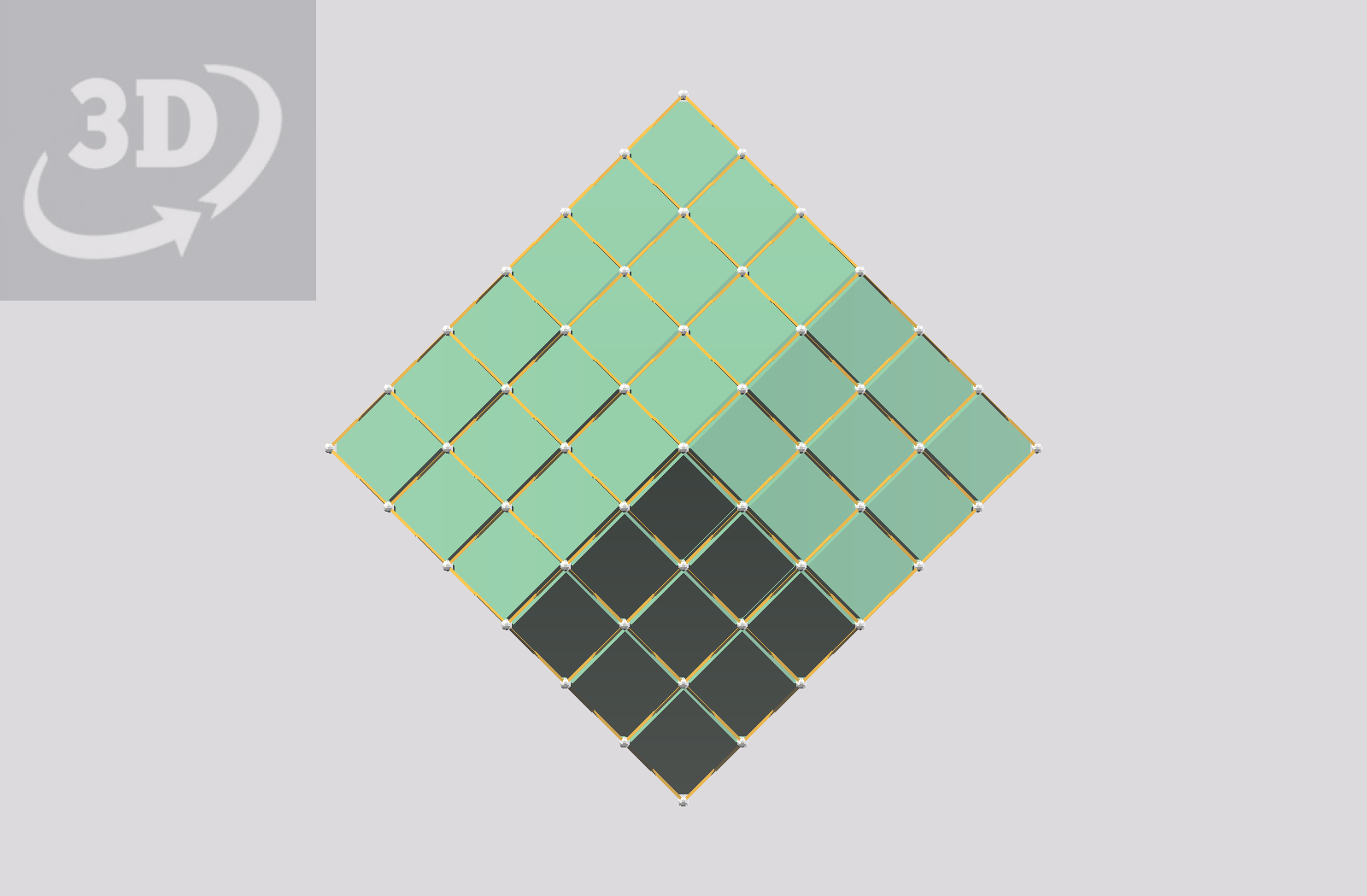
This explores packing of cells in a BCC diamantine grid. Cells are basically rhombic hexahedra, or rhombs. These rhombs have some edges chamfered and some grooved, partly to enhance the cellular packing aspect of arrays. The last Scene shows a single cell as a voxel, framed by a hexahedron. The next to last scene shows an array of such voxels. In reference to the Double RD cited in the link above, this array is a partially filled out packing of 32 voxels. This packing can be composed in a number of ways as puzzles, designed by myself and others. Any of these serve as the core of this example of Triple RD, in which 108 cells fill out a Rhombic Dodecahedron grid.
Packing of these cells can be compared to packing of cubic cells. Many configurations of pieces can be made as puzzles. Some, like a Soma cube, simply stack, while others interlock. In this exploration, comparable groupings of cells as pieces of puzzles can be made, but in a 4-directional grid. The focus here is on the 76 cells in what can be called the third layer. In Scenes, what is shown is 4 pieces that combine sequentially to interlock, completing the third shell. This is moderately challenging as a puzzle, and is an example, one of many possibilities. These would include groupings of cells that do not maintain separation of the 32 cell core from the third shell, which could make for more challenging puzzles.
A 3D design created in vZome. Use your mouse or touch to interact.
Four pieces
Assembly