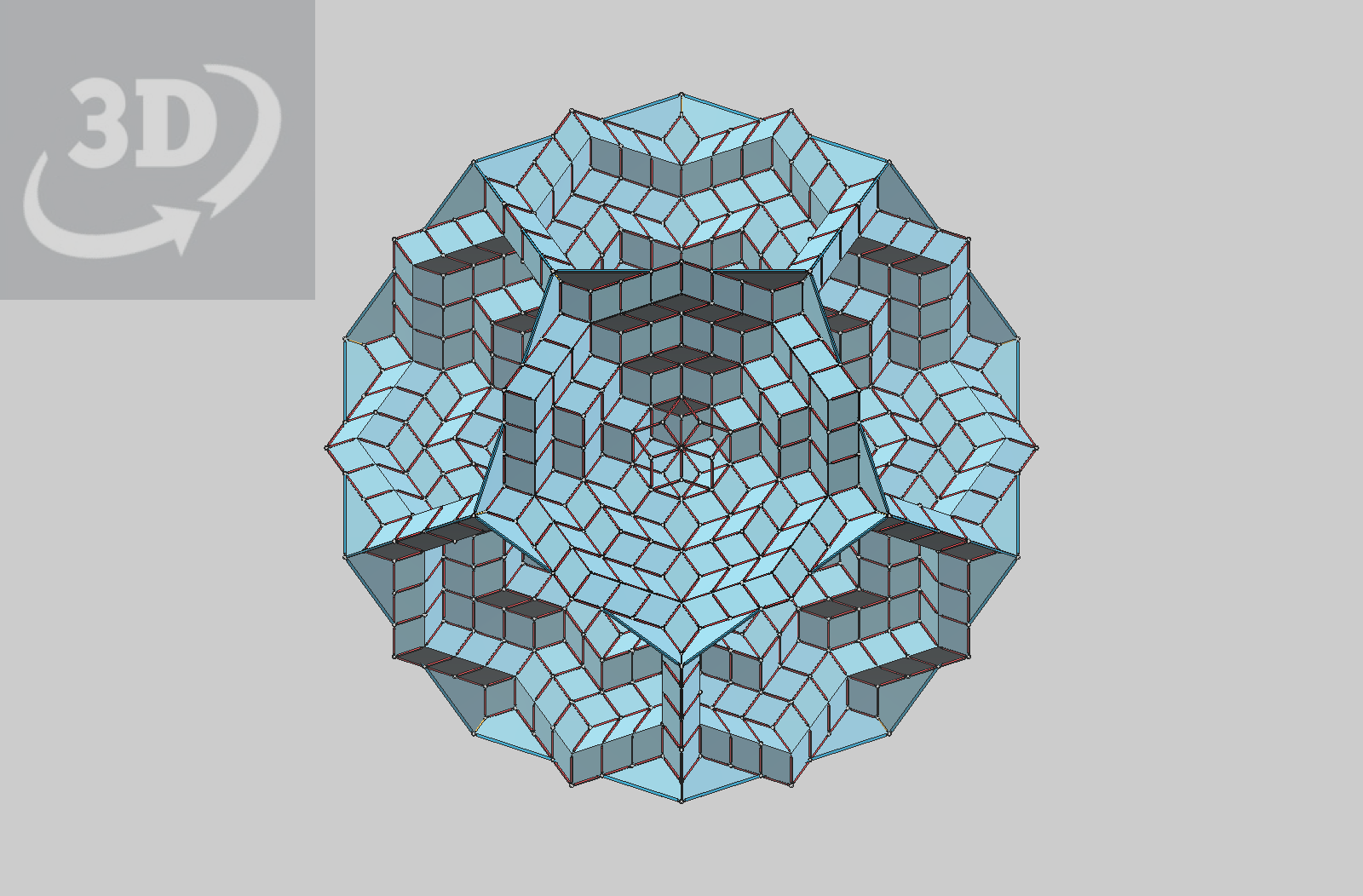
This is an exploration of space filling with elements of Icosahedral symmetry. Elements are unit length struts that align with any of the radial lines of a regular Icosahedron, which can be seen as a 6 directional coordinate system. Polyhedra are composed with edges of these unit lengths, the major one being a Rhombic Triacontahedron. This is a zonohedron with six directions of edges. Each zone can be independently varied in length, and minor polyhedra can be defined by reducing some of the zones of edges to zero length. Reducing, or eliminating one zone yields a Rhombic Icosahedron. By the same token, dodecahedra can be composed using 4 of the 6 coordinate directions, and hexahedra using selections of 3 of the 6. The hypothesis of this study is that using polyhedral cells with all unit edge lengths drawn from the 6 coordinate directions, a combination can be found that packs to fill space with no voids or overlaps. What is shown here is a pattern that evidently does this, as far as it goes. It is a recursive composition, progressing out radially from an origin point, and thus the premise is that it can be continued. Scenes show the sequence, primarily looking at one of the 12 regions bounded by planes defined by adjacent vertices of a dodecahedron and its’ center. What is illustrated in titled scenes is that starting from a cluster of 12 Triacontahedra around a center, double edge length, or 2-frequency Triacontahedron shells, or hulls, can be positioned so that each one intersects the boundary planes of a region with 5 of its’ planes coplanar with the boundary, and 20 planes, or 2/3 of the shell, projecting outward from the boundary. At this position, the space between the 20 plane portions of the inner Triacontahedron and of the 2-frequency one that are bounded by the 5 planes can be filled with a combination of the reduced, or minor cells as described. In a like manner, the space between the 2/3 shells of a 2-frequency Triacontahedron and of a 3-frequency Triacontahedron intersecting the boundary planes in these positions can be filled with a combination of minor cells. The bridgework of hexahedral cells shown in the first and second scenes is partitioned by the boundary planes, so all of these cells are shared between adjacent regions, and complete the packing array. While this kind of modeling isn’t a proof, it’s within reason to speculate that this pattern, verified thus far, could be carried out recursively through n-frequency stages.
The pattern shown here has Icosahedral symmetry at each completed stage. The triacontahedral, icosahedral, and dodecahedral cells can all be dissected into hexahedra of 2 types, prolate and oblate. Thus the entire array can be composed of the 2 types of hexahedron, but doing so reduces the overall symmetry.
A 3D design created in vZome. Use your mouse or touch to interact.
A sequel to this can be seen at 6 Direction Array Construction