.
This is a continuation of exploration of space filling with elements of Icosahedral Symmetry.
This is a sequel to 6 Directions Array
A 3D design created in vZome. Use your mouse or touch to interact.
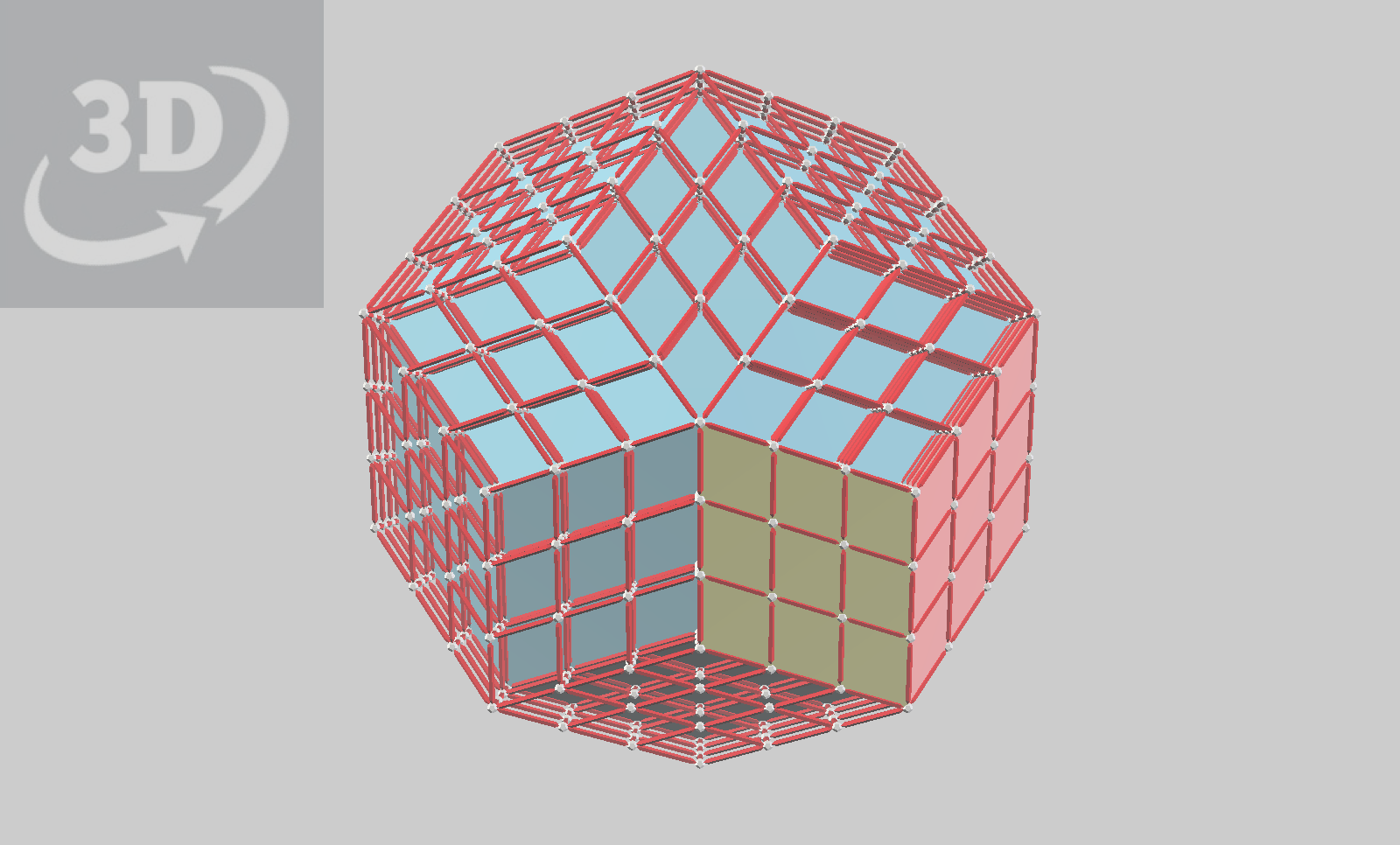
Here is shown a breakdown of the composition of this version of 6 directional array. The first scene shows the partial dissection of the 1, 2, and 3 frequency Rhombic Triacontahedra, or RTs. The simple RT is dissected as described above, with one zone of hexahedral cells deleted, leaving a Rhombic Icosahedron, or RI. In place of the 10 cells that were deleted, 2 are shown, 1 colored red for the flattened, or oblate type, and 1 yellow for the pointy, or prolate type. Looking at the 2 and 3 frequency stages, the same coloring is used to indicate how the same dissection is used at each stage. Thus in the 2nd stage, double edge lengths means that a block of 2x2x2 = 8 cells occupies the same relative position, and in the 3rd, triple edge length means a block of 3x3x3 = 27 cells occupies the same relative position. This strategy allows simplifying the composition process by looking at just the inner 2/3 of the 2nd and 3rd stages. However, where the original RT has an RI left, the inner 1/3 of these stages must merge with the array within. The second scene shows a 2 frequency RT with a cavity that the original RT fits into. The third scene shows a transition segment between 3rd stage and 2nd stage, which simplifies the modeling to verify that the outer and inner parts of the array do indeed merge. The fourth scene shows a 3 frequency RT filled out, with a cavity that the 2 frequency RT fits into. The fifth scene shows these several parts merged.
It is very probable that other paths in this system that define other arrays of packed cells can be found.